Learn the 2026 crypto bot landscape in one read. See which providers fit your workflow, when each bot type shines, and what risks to watch.
Crypto bots in 2026: the 3 things you must know
TLDR
Bots won 2026. Most venues ship built-in automation, pro SaaS stacks move fast, and open-source lets quants go wild. If you are not automating, you are trading against something that is.
Pick your home first. Exchange for speed and native order types. SaaS like BuddyTrading for no-code builds, backtests, and copy workflows. Open-source for full control and research.
Match bot to market, not vibes. Sideways → Spot Grid. Trend → Indicator strategies. Moving size → TWAP or VWAP. Futures → watch funding and liquidation distance.
Risk is bigger than PnL. Guard API keys, plan for cloud outages, set venue-side TP and SL, and never trust pretty backtests without live stats.
Fastest on-ramp. Copy a vetted pro bot on BuddyTrading, start tiny, review live drawdowns, then scale with confidence.
Bottom line: automate smart, protect keys, copy what works, and let data decide the upgrade path.
1) The landscape is mature and more accessible
Exchanges ship built-in bots you can start in minutes. Binance and OKX publicly document Spot Grid, Futures Grid, DCA/Auto-Invest, Rebalancing, plus execution algos like TWAP, VWAP, and Iceberg. Many also run signal marketplaces to follow third-party strategies.
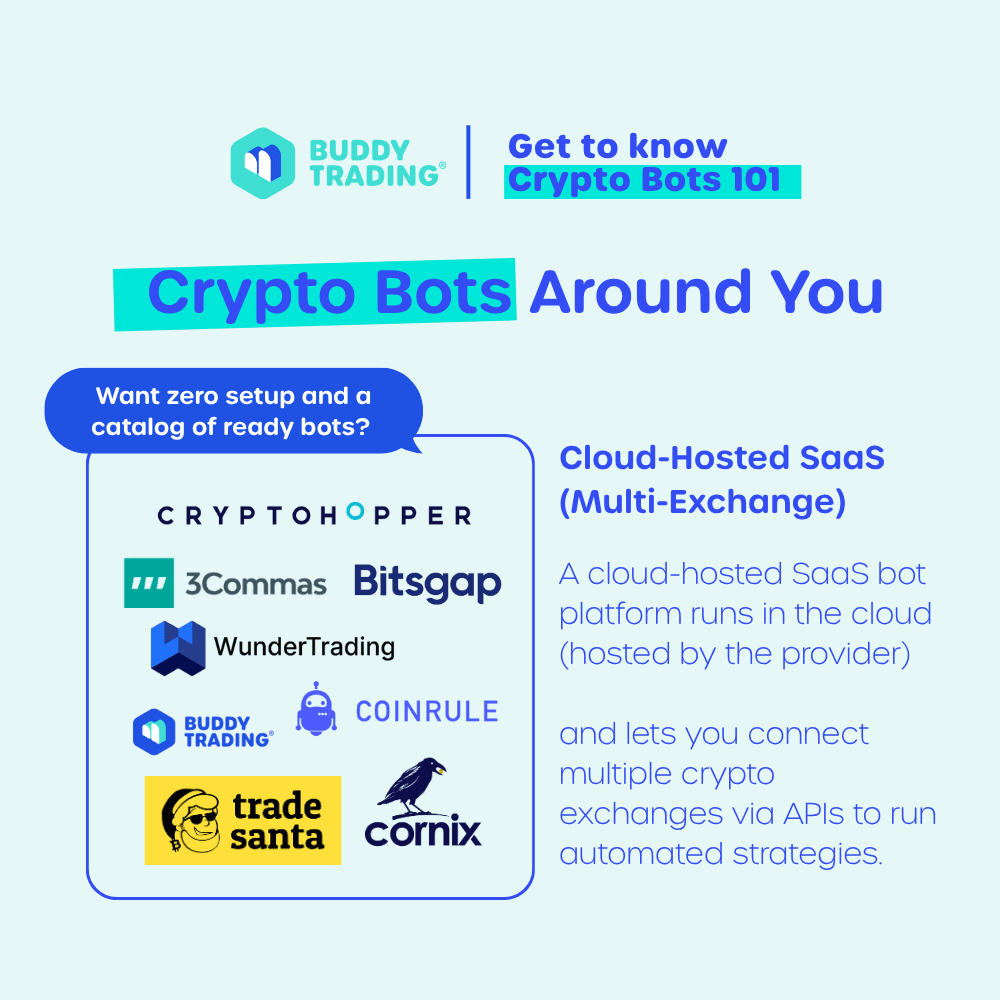
SaaS platforms give no-code strategy builders and DCA bots with indicator gating, while open-source frameworks let you code anything and backtest with full control. See 3Commas and Cryptohopper for indicator-driven DCA and strategy designers, and Freqtrade and Hummingbot for self-hosted code, backtesting, and market-making or arbitrage.
Why this matters in 2026
You can start simple on an exchange UI, then graduate to SaaS for rule complexity, then go open-source for full control and custom infra, all with documented features and public references.
2) Providers: how to pick the right home for your bots
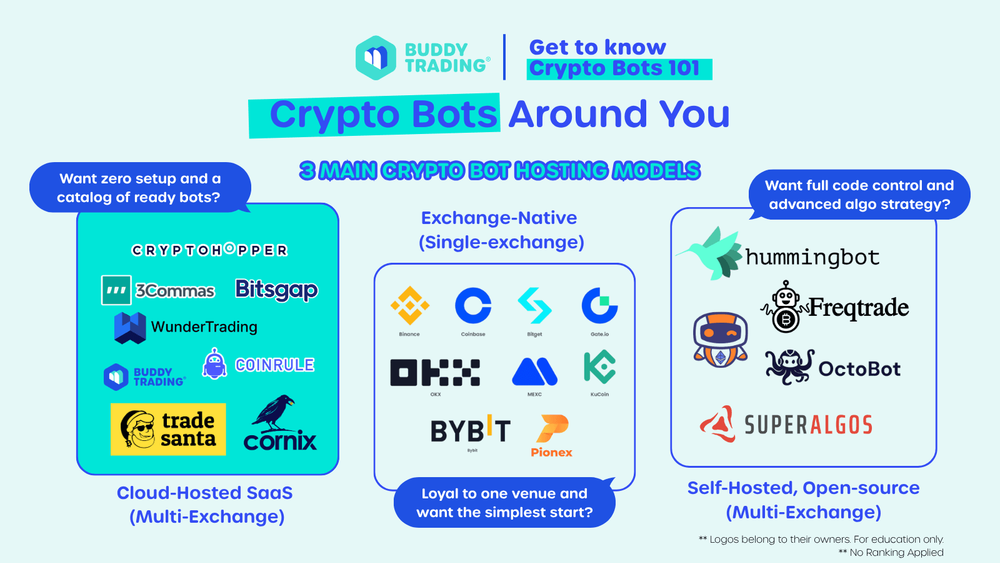
The three hosting models
Your provider choice decides speed, control, and how much infrastructure risk you carry.
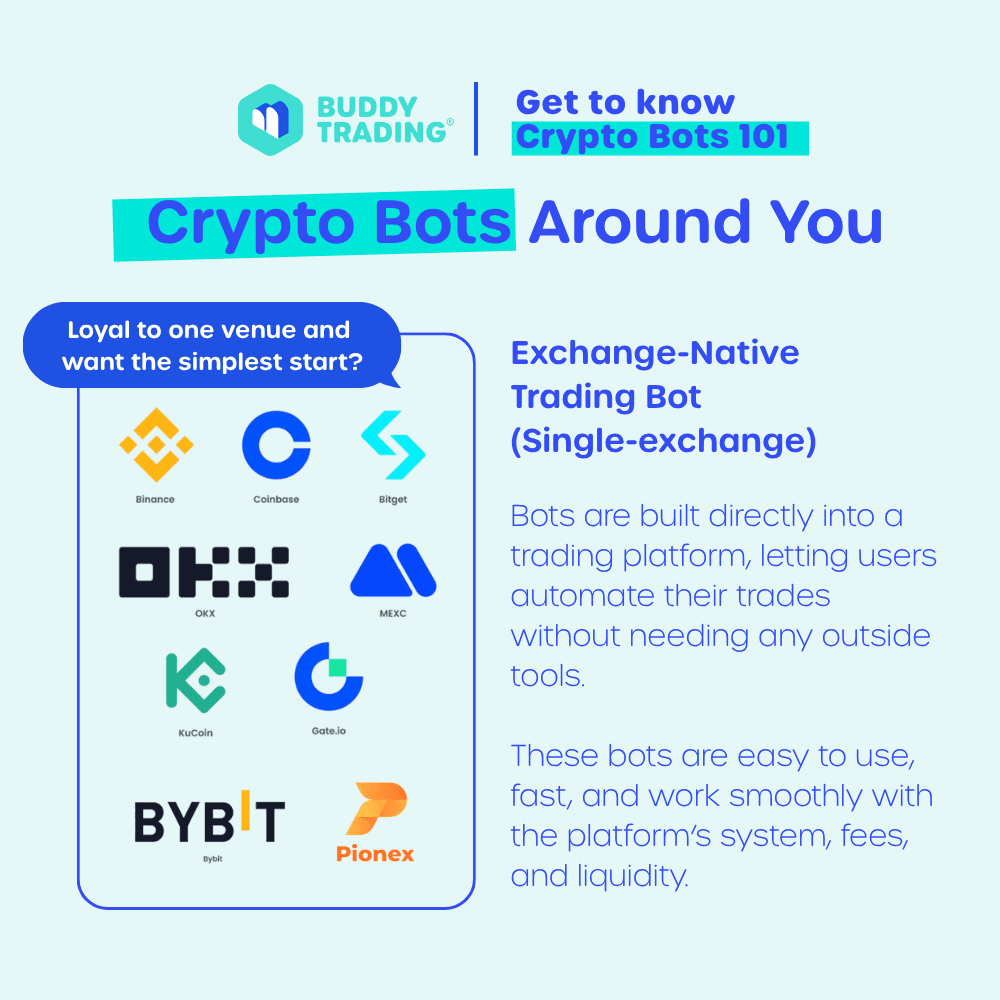
A) Exchange-native
Binance, OKX, Pionex
Strengths: fastest start, lowest friction, venue order types like Iceberg, TWAP, VWAP, custody stays on the exchange.
Crypto bots and 4 things you need to know before using in 2026 | BuddyTrading Blog
Trade-offs: limited strategy breadth, you can only trade on that one exchange, fewer cross-venue workflows.
Best if: you want reliable execution on a single venue, simple to medium strategies, and minimal setup.
Trade-offs: cloud dependency, subscription costs, variable transparency by vendor.
Best if: you want to iterate fast, test multiple ideas, or copy vetted bots.
Note: BuddyTrading adds AI-assisted prompts for strategy creation and a pro-bot marketplace.
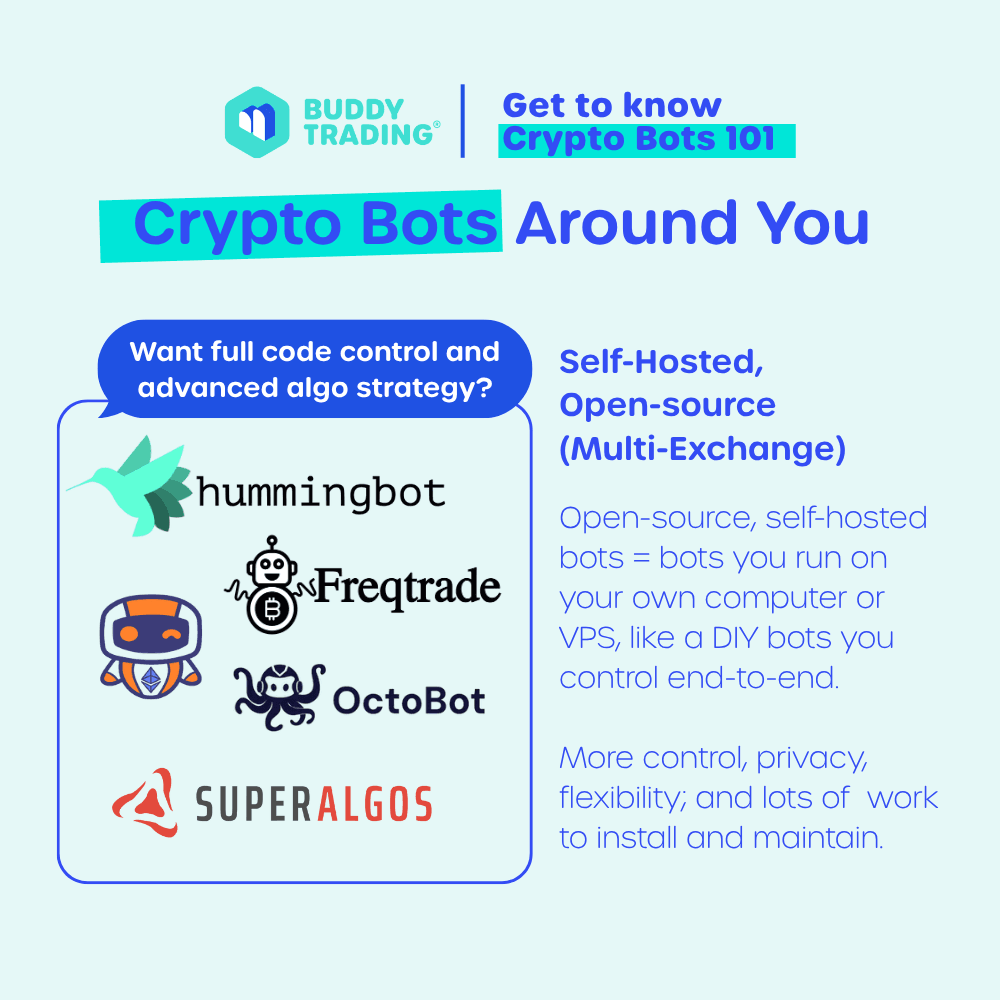
C) Open-source frameworks
Freqtrade, Hummingbot, Jesse
Strengths: full code and logs, local or VPS control, advanced modules like market-making or arbitrage, reproducible research.
Trade-offs: higher setup effort, you own monitoring and ops.
Best if: you need custom logic, strict research workflow, or pro execution patterns.
Quick chooser
Need speed and simple scope → Exchange-native
Need flexibility and copy or publish → SaaS
Need full control and research rigor → Open-source
Visit our Crypto Bot 101 series for a deeper comparison matrix of these three models.
3) Bot categories, ranked by setting complexity
Different bot families target different market states, but the number of knobs you must set is what often decides success. More complexity means more power and also more room for error. We rank by setup complexity, then note where each shines.
Basic
Spot Grid
What it is: buys lower, sells higher within a price band.
Strongest at: sideways or choppy markets.
Where to run: major exchanges and SaaS, BuddyTrading included.
DCA
What it is: scheduled or conditional averaging into a position.
Strongest at: long-term accumulation and volatile dips.
Where to run: exchanges and SaaS, BuddyTrading included.
Rebalancing
What it is: maintains target portfolio weights.
Strongest at: passive portfolios that drift over time.
Where to run: exchanges and SaaS.
Medium
Futures Grid
What it is: grid logic with long or short and leverage.
Strongest at: volatile regimes when you manage liquidation distance and funding.
Where to run: exchange futures, SaaS, BuddyTrading.
Indicator strategies
What it is: rules from RSI, EMA, MACD, Bollinger and filters.
Strongest at: systematic entries and exits in trends or ranges.
Where to run: SaaS, BuddyTrading, open-source.
Execution algos
TWAP, VWAP, Iceberg
What they do: slice or hide size for better fills, not signal generation.
Strongest at: moving larger orders with less slippage.
Where to run: exchange UIs and APIs, SaaS connectors.
Advanced
Arbitrage
What it is: cross-venue, triangular, or spot-perp funding capture.
Strongest at: market-neutral edges when fees, latency, and inventory are controlled.
Where to run: Hummingbot modules or custom, BuddyTrading plugins when available.
Market-making
What it is: quoting both sides and managing inventory to earn the spread.
Strongest at: liquid pairs with stable microstructure and clear risk limits.
Where to run: Hummingbot, custom connectors.
Custom or multi-signal strategies
What it is: layered indicators, filters, and risk models, coded or AI-assisted.
Strongest at: tailored edges that need full control and versioned research.
Where to run: Freqtrade, Jesse, BuddyTrading build and publish.
Cheat sheet, by market condition
Sideways → Spot Grid or mean-reversion recipes
Trending → indicator strategies like EMA crossover or breakout
Large orders → TWAP or VWAP, Iceberg for discretion
Futures exposure → Futures Grid or indicator strategies, monitor funding and liquidation distance
4) Risks you must manage in 2026 (read this before you connect a key)
“We’ll set up the bot for you” = API-key theft risk
Scammers pose as helpers, then ask for your API trading keys (or trick you into connecting a bot to their app). Keys with trading permission let them place ruinous trades, churn fees, or drain value via bad positions even if withdrawals are disabled. U.S. regulators explicitly warn that “AI/bot” claims and guaranteed returns are red flags. Use least privilege, IP allow-listing, rotation, and never share keys with individuals.
Mitigate
Create single-purpose keys: trading only (no withdrawals), IP-whitelisted, rotated periodically. Monitor and revoke instantly on anomalies. Binance’s guidance is a good baseline.
Stick to vetted platforms with transparent security pages and public incident handling. Note: in 2022, 3Commas confirmed an API key data leak—proof that even legit services can be compromised; treat all keys as sensitive.
Cloud dependency: when your bot platform’s cloud goes down, your bot goes down
Most SaaS bots run on hyperscale clouds. Major AWS outages (US-EAST-1) in October 2025 knocked out thousands of apps globally, from fintech to consumer apps. If your platform sits on a single region/provider, your stops, signals, or automations can stall at the worst time. Build for failover and exchange-side safety.
Mitigate
Prefer platforms that publish a status page, run multi-region deployments, and document degradation modes (what still works if their cloud is down).
Put server-side TP/SL and conditional orders on the exchange when possible, so protection lives on the venue even if a SaaS link breaks.
Keep a manual playbook (how to close positions directly on the exchange) for cloud incidents.
Execution & venue risk still applies
Thin books, slippage, delays, and bad settings are on you. Read the exchange’s risk disclosures, loss can be substantial, and bot UIs don’t remove market risk.
Mitigate
Test on small size, then scale. Use partial fills, price limits, and sanity checks (max order size, max leverage).
Futures-specific drags: funding & liquidation
Perpetuals charge funding fees between longs and shorts; that recurring payment can quietly erode returns. Keep liquidation distance wide; set hard stops that don’t rely on an external bot being online.
Mitigate
Track funding before enabling any futures bot; pause or reduce sizing when funding turns expensive.
Backtests and “pro bot” claims can lose by overfitting
Great-looking backtests are easy after trying many parameter combos. This is backtest overfitting; use forward tests and sanity metrics (e.g., Deflated Sharpe Ratio) before trusting performance claims.
Mitigate
Demand out-of-sample and live stats (win rate, drawdown, number of trades) and a minimum live track record before you copy.
Trade with confidence: copy pro bots on BuddyTrading
If you prefer a faster on-ramp, copy a proven bot on BuddyTrading, then watch how it performs, and scale only after you learn its rules and risk. Pair copying with your own filters and backtests so you understand drawdowns before you size up.
Quick start
Pick a bot with transparent rules and recent backtests result.
Allocate small, monitor funding or fees if it touches perps.
Scale gradually once you understand its edge and its worst case.

 Our Blog
 8 min read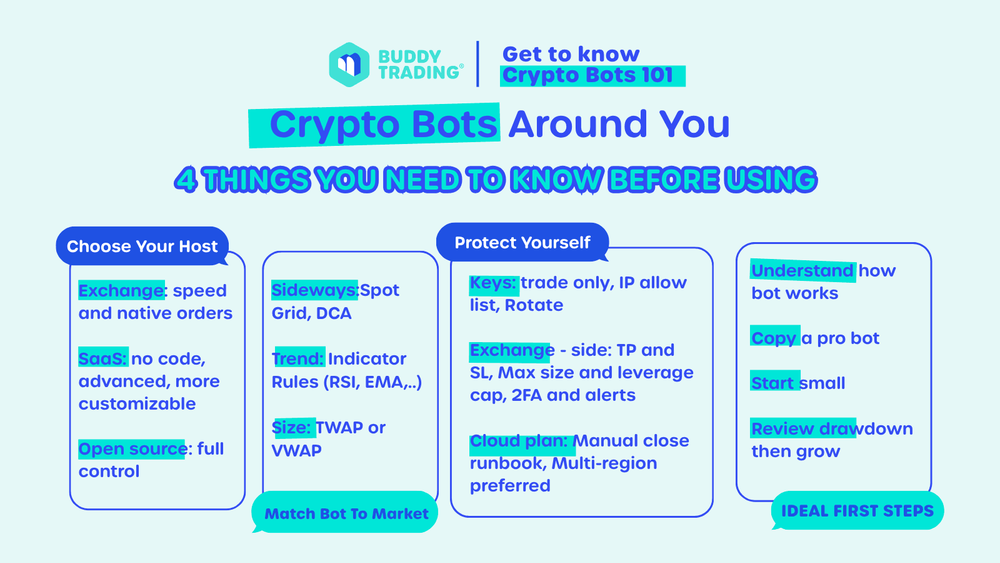
 C) Open-source frameworks
 Quick chooser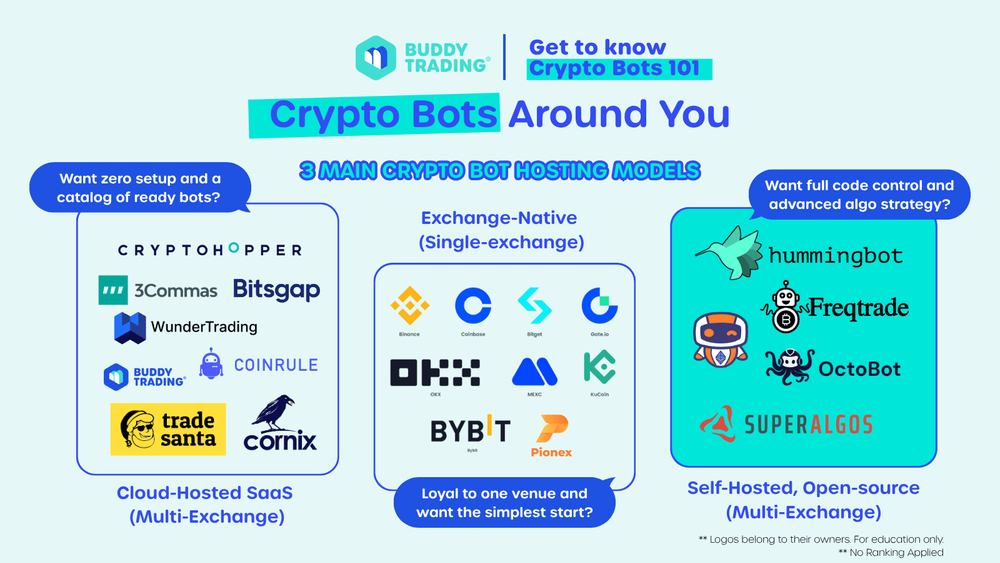
 Oct 23, 2025