In the world of crypto, one metric quietly shapes the behavior of traders and investors alike: Bitcoin Dominance (BTC Dominance). While it’s often discussed in the context of altcoin seasons and market cycles, its influence extends deeper—especially into the strategies used by lead traders and the decisions of copy traders. If you’re using a copy trading platform like BuddyTrading, understanding BTC dominance can help you interpret trader behavior, manage your risk, and better time your capital
In the world of crypto, one metric quietly shapes the behavior of traders and investors alike: Bitcoin Dominance (BTC Dominance). While it’s often discussed in the context of altcoin seasons and market cycles, its influence extends deeper—especially into the strategies used by lead traders and the decisions of copy traders.
If you’re using a copy trading platform like BuddyTrading, understanding BTC dominance can help you interpret trader behavior, manage your risk, and better time your capital allocation.
Let’s break it down.
What Is BTC Dominance?
BTC Dominance refers to the percentage of the total crypto market capitalization that is held by Bitcoin.
For example:
If the total market cap of all crypto assets is $2 trillion
And Bitcoin’s market cap is $1 trillion → Then BTC dominance is 50%
It’s a macro-indicator of how much attention and capital is flowing into Bitcoin compared to altcoins.
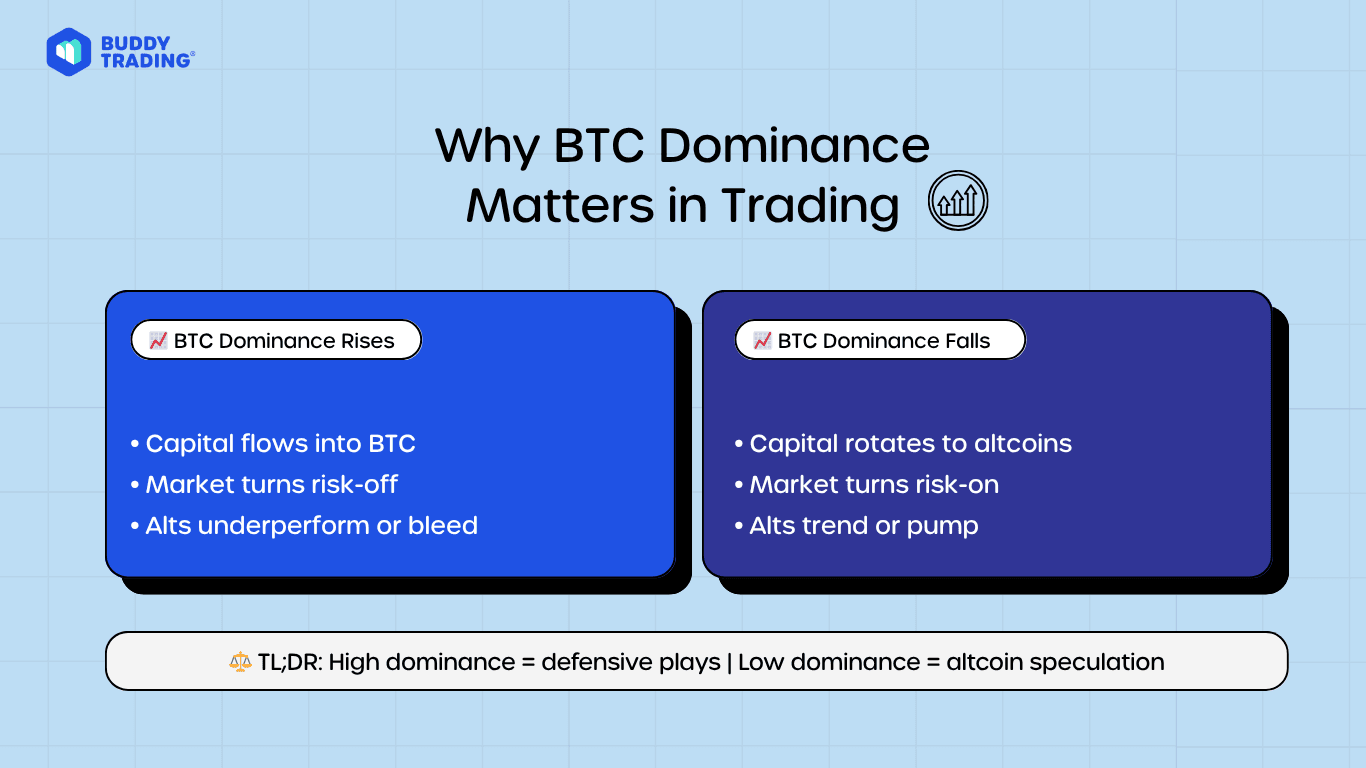
Why BTC Dominance Matters in Trading
BTC Dominance is not just a number—it reflects market sentiment, risk appetite, and the capital rotation cycle across the crypto space.
Here’s what the general trends mean:
BTC Dominance Rises
BTC Dominance Falls
Traders prefer BTC over altcoins
Traders are rotating capital into altcoins
Market is risk-off
Market is risk-on
BTC is outperforming most alts
Alts are gaining faster than BTC
Altcoins may underperform or bleed
Altcoins may pump or trend strongly
In short:
What BTC Dominance Means for Copy Trading Strategies | BuddyTrading Blog
High BTC Dominance = Safer plays, defensive positioning
Lead traders adjust their portfolio allocation based on BTC dominance.
When BTC dominance is rising:
Traders may focus on BTC and ETH pairs
They may take fewer altcoin positions
Copy trading strategies tend to be more conservative and low-volatility
When BTC dominance is falling:
Traders may pivot to trending altcoins
More speculative, high-risk/high-reward strategies appear
Volatility increases, but so does potential upside
As a copy trader, it’s important to ask:
Is the strategy designed for BTC-led conditions?
Does the trader know how to pivot during altcoin runs?
2. Timing Your Entry Matters
Copying a trader who is heavily invested in altcoins right before BTC dominance spikes could be risky. In such phases, altcoins often lose value even if BTC remains stable or rises—this is known as altcoin bleed.
Likewise, joining a copy trader when BTC dominance is peaking and beginning to fall could position you for front-row exposure to an altcoin rally—if the trader pivots early.
This is where using BTC dominance alongside your copy trade entry can enhance timing and avoid drawdowns.
3. Understand Trader Risk Exposure
Traders who specialize in low-cap altcoins during falling BTC dominance are inherently more volatile. Their ROI might look explosive short-term, but their strategies often underperform when BTC dominance rebounds.
You need to match your risk profile to:
The trader’s asset allocation style
The current macro conditions (signaled by BTC dominance)
How quickly they adapt to shifts in capital rotation
BuddyTrading's trader insights and trade histories help you observe this in action.
Real-World Examples
Let’s say BTC dominance is rising rapidly due to macro uncertainty or ETF hype.
A top lead trader on BuddyTrading might:
Close out riskier alt positions
Shift to BTC/USDT swing trades
Tighten stop-losses and reduce exposure
Meanwhile, a trader who refuses to adjust might:
Hold low-liquidity altcoins into a bearish phase
Suffer portfolio losses while BTC holds firm
Lose copy traders who don’t want to absorb the volatility
As a copy trader, evaluating how each trader reacts to dominance shifts gives you a huge edge in capital preservation.
How to Use BTC Dominance in Your Copy Trading Strategy
Here are a few smart tips:
Track BTC Dominance Trends Weekly Use platforms like TradingView or CoinMarketCap to chart BTC dominance.
Check Trader Allocations Before Copying Are they 80% in low-cap alts while dominance is spiking? That’s risky.
Diversify Based on Dominance Allocate capital to both BTC-dominant and altcoin-focused traders during transition phases.
Read Performance in Context A drop in a lead trader’s ROI may not mean poor skill—it could simply be the result of a temporary dominance shift.
Time Campaigns and Promotions If you’re part of a copy trading campaign, align your messaging and risk-level with the macro dominance trend.
Conclusion
BTC dominance isn’t just a technical metric for chart watchers—it’s a powerful lens through which you can understand trading strategy behaviors, market trends, and portfolio risk in the copy trading world.
At BuddyTrading, we’re building tools to help copy traders make more informed decisions—beyond just ROI numbers. Understanding BTC dominance is one more way to trade smarter, not harder.

 Our Blog
 5 min read

 Jul 21, 2025