A login link has been sent to your inbox. If it doesn't arrive in 3 minutes, be sure to check your spam folder.
 Our Blog
Decentralized Finance (DeFi) has unlocked massive opportunities for traders and investors, offering permissionless access to token swaps, lending, yield farming, and more. But behind the innovation lies one of the most overlooked and misunderstood dangers: liquidity risk. In this article, we’ll explore what liquidity risk means in the context of DeFi, why it matters to traders (especially copy traders), and how you can protect yourself from unexpected losses. What is Liquidity Risk?
Decentralized Finance (DeFi) has unlocked massive opportunities for traders and investors, offering permissionless access to token swaps, lending, yield farming, and more. But behind the innovation lies one of the most overlooked and misunderstood dangers: liquidity risk.
In this article, we’ll explore what liquidity risk means in the context of DeFi, why it matters to traders (especially copy traders), and how you can protect yourself from unexpected losses.
What is Liquidity Risk?
Liquidity risk refers to the difficulty or cost of converting an asset into cash without affecting its price. In traditional finance, this might happen when you try to sell a large number of shares in a stock with low daily trading volume. In DeFi, it can be even more severe.
On-chain, liquidity depends on the availability of tokens in decentralized exchanges (DEXs), automated market makers (AMMs), or liquidity pools like those on Uniswap, Curve, or PancakeSwap. If there’s not enough liquidity, even small trades can result in:
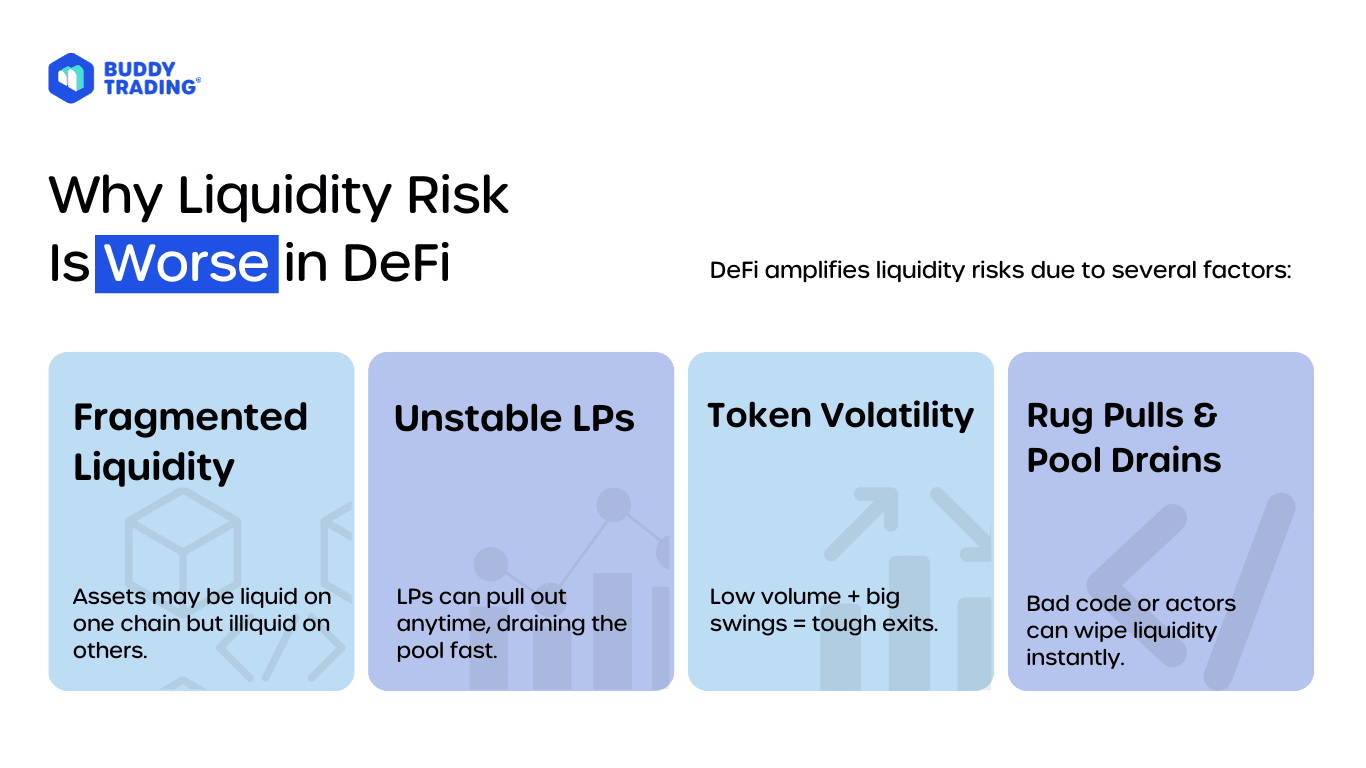
DeFi amplifies liquidity risks due to several factors:
Unlike centralized exchanges (CEXs) that aggregate global liquidity in one place, DeFi has hundreds of DEXs and Layer 2s. A token might have high liquidity on Arbitrum but almost none on Polygon.
Liquidity providers (LPs) can withdraw their funds at any time. If too many LPs exit a pool, the remaining liquidity can dry up fast, leaving traders stuck.
DeFi tokens are often highly volatile and thinly traded. A price dump combined with poor liquidity can trap traders in positions they can’t exit without major loss.
Malicious projects might pull liquidity intentionally (a “rug pull”), or poorly written smart contracts might get exploited, draining liquidity pools instantly.
If you’re a , you might be tempted to follow high-performing lead traders trading exotic DeFi tokens. But before you follow, ask:
Copy trading in DeFi adds another layer of complexity—if the lead trader exits early but you get stuck in a low-liquidity asset, you bear all the downside.
Here are some practical strategies to mitigate liquidity risk:
Use tools like DexTools, GeckoTerminal, or DeFiLlama to check trading volume and liquidity pool depth for any token.
Don’t just copy a trade—adjust your slippage settings cautiously. High slippage can lead to disastrous fills.
Pairs with less than $50K–$100K in liquidity are usually high-risk. For bigger trades, look for deeper pools.
If you're copying a lead trader, choose those who trade top-tier or mid-cap DeFi tokens. Avoid those chasing pump-and-dump microcaps.
Platforms like 1inch or Matcha route your trade through multiple DEXs to get the best execution and reduce the impact of thin liquidity.
Liquidity is the lifeblood of any market, but in DeFi, it's a fragile and fast-moving target. Traders—especially copy traders—must be extra cautious when following others into low-cap or high-risk DeFi tokens.
Understanding liquidity risk is not just about being safe—it’s about being smart. Use the right tools, ask the right questions, and never risk more than you can afford to lose in a market that’s still evolving.
TL;DR
📢 Join the BuddyTrading community today!
🌐 Visit us: BuddyTrading.com
🐦 Follow us: @BuddyTradingApp
💬 Stay updated: https://t.me/BuddyTradingApp
🚀 Stay ahead with expert insights & real-time updates!

Subscribe to our newsletter and be the first to access exclusive content and expert insights.



 4 min read